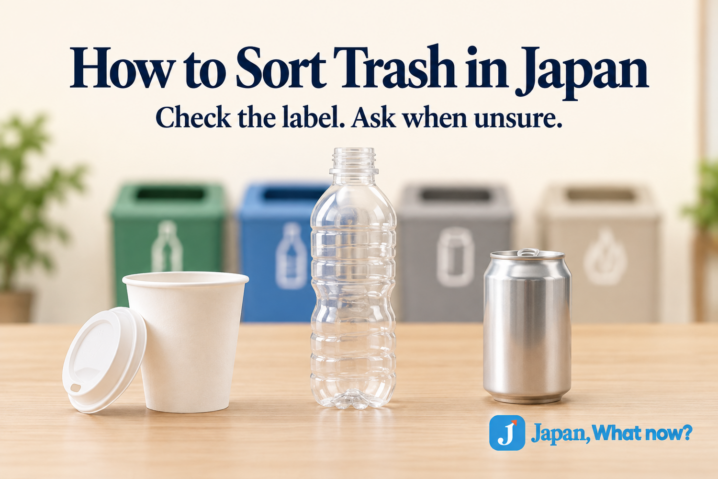
You have finally found a bin—but there are several openings, and your empty coffee cup does not seem to match any of the pictures. What now?
Read the labels at that location, match your item to the accepted waste, and ask staff if you are unsure. Sorting instructions vary by city and facility; one rule learned elsewhere may not apply here.
Start with the label, not the color
Look for words, pictures and examples of accepted items before putting anything in. Treat the color as a visual clue, not a rule you can carry from one place to the next. GO TOKYO advises visitors to check the labels and use the correct bins. If no suitable bin is available, keep your rubbish with you. GO TOKYO sightseeing tips
You do not need to memorize an entire city’s collection system for a short visit. At a café, follow the café’s disposal signs. At your accommodation, follow the host’s or hotel’s instructions.
Japanese bin labels you may see
These translations help you recognize categories. They are not a nationwide list of what each bin accepts.
| Japanese label | Meaning | What to check |
|---|---|---|
| 燃えるごみ / 燃やすごみ | Burnable waste | Use the examples on the local sign. |
| 燃えないごみ / 不燃ごみ | Non-burnable waste | The accepted materials depend on the local rules. |
| 缶 / あき缶 | Cans / empty cans | Check whether the collection is for drink cans. |
| びん / ビン | Glass bottles | Do not assume other glass objects belong here. |
| ペットボトル | PET bottles | This does not mean all plastic items. |
| プラスチック / プラ | Plastic | Check which products or packaging are accepted. |
For example, Shinjuku publishes separate instructions for burnable waste, recyclable plastic and PET bottles. Its household system is a local example—not a rule for every public bin in Japan. Shinjuku waste guidance, Shinjuku recyclable plastic guidance
One takeaway drink can mean several decisions
A cup, lid and straw may need different bins. Before pulling everything apart, look at the disposal station or ask the shop. Follow any instructions for leftover liquid as well; do not pour it into a recycling opening.
A paper-looking cup is not automatically suitable for a paper-recycling bin. For example, Shinjuku’s resident guide excludes paper cups from its recyclable paper collection. That illustrates why appearance alone can be misleading. Shinjuku living guide
What should you do with a PET bottle?
Empty it before recycling. The Japan Soft Drink Association explains that leftover drinks interfere with recycling and that disposal rules are set locally. Japan Soft Drink Association
Check the instructions for caps, labels and rinsing. At a rental or hotel, ask where each part should go. Shinjuku’s household guidance, for instance, separates PET bottle caps and labels into recyclable plastic. Do not assume every public collection box has that same arrangement. Shinjuku bottle-recycling guide
Can a takeaway cup go in the box beside a vending machine?
No: the drink-container collection boxes beside vending machines are not general trash bins. They are intended for empty beverage containers such as the bottles and cans indicated. The industry association specifically lists disposable coffee cups and food containers among unsuitable items. Japan Soft Drink Association: collection boxes
What if you still cannot tell?
Keep the item with you and ask a staff member. Showing the empty container can make the question easier to understand. A small bag helps you carry it until you reach a suitable disposal point.
If you are staying in a rental, ask your host about the correct bags, collection point and timing before putting waste outside. For a hotel stay, ask reception how to handle anything that does not clearly fit the room’s bins.
The aim is not to get every label right from memory. **Pause, read, and ask when the item does not clearly match.