When you suddenly feel unwell while traveling, many foreign visitors in Japan aren’t sure which hospital or which department to go to first. Japanese medical institutions divide specialties clearly by symptom, so visiting the wrong department can mean you’re turned away or sent from place to place. Here’s how to choose the right department by symptom, along with key points to know when looking for a hospital.
The Difference Between “Hospitals” and “Clinics”
In Japan, large general hospitals and smaller neighborhood clinics play different roles. For relatively minor symptoms like a common cold or a scrape, it’s standard to visit a nearby clinic first. Going directly to a large hospital without a referral letter can add an extra fee (a “selection treatment fee”), so unless it’s an emergency, it’s best to look for a nearby clinic.
Which Department to Visit, by Symptom
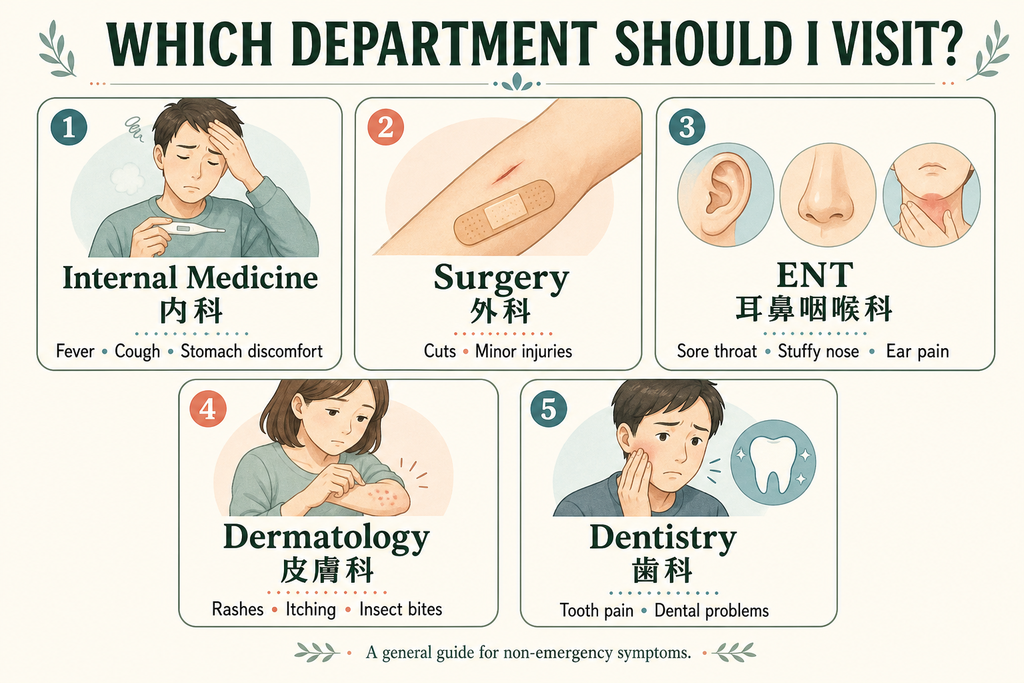
- Internal Medicine (内科): For fever, coughing, stomach pain, headaches, and other whole-body symptoms without an obvious cause, start with internal medicine. When in doubt, this is a safe first stop.
- Surgery (外科): Visit surgery for cuts, bruises, or suspected fractures.
- ENT / Otolaryngology (耳鼻咽喉科): Handles sore throats, stuffy noses, and ear pain.
- Dermatology (皮膚科): Handles rashes, itching, insect bites, and sunburn-related skin irritation.
- Dentistry (歯科): Tooth pain is handled by dentistry, not internal medicine — worth remembering.
Not Sure Whether to Call an Ambulance?
If there’s an obvious emergency — loss of consciousness, severe chest pain, heavy bleeding — don’t hesitate to call an ambulance at 119. On the other hand, if you’re unsure whether your symptoms are serious enough to need a hospital right away but not serious enough for an ambulance, some areas offer a phone consultation line called “#7119” (the Emergency Safety Center service). A nurse or other medical professional will ask about your symptoms and advise whether you need care and where to go nearby.
Finding a Hospital That Can Help in Your Language
If you’re not confident in Japanese, it’s reassuring to look for a medical facility that offers support in English or another language. Services like the AMDA International Medical Information Center offer multilingual phone consultations that can point you toward suitable facilities. Hotel concierges and larger hospitals can also often recommend nearby facilities that accommodate foreign patients.
For Minor Symptoms, a Drugstore Is Also an Option
For minor symptoms that can be managed with over-the-counter medicine — a cold, an upset stomach, mild pain — you can describe your symptoms to a pharmacist at a drugstore and purchase an appropriate remedy. That said, if symptoms persist or get worse, be sure to see a doctor.
Common Misunderstandings About Seeing a Doctor in Japan
- Assuming any hospital will accept your insurance: Japan’s public health insurance is generally for people enrolled in the Japanese system, so visitors from abroad typically pay the full cost out of pocket. Travel insurance purchased before your trip offers peace of mind.
- Assuming bigger hospitals mean faster care: Large general hospitals can mean longer wait times and extra fees without a referral letter, so a smaller clinic is often faster for minor symptoms.
- Assuming internal medicine is always the right choice: Depending on your symptoms, a specialist department like ENT or dermatology can get you appropriate treatment faster.
- Calling an ambulance casually because it’s free: Ambulances in Japan are free to call, but non-emergency use is discouraged. If you’re unsure, a consultation line like #7119 is a good alternative.
- Confusing pharmacies with drugstores: A pharmacy fills prescriptions, while a drugstore sells over-the-counter medicine — a distinction worth knowing.
What Should You Do in These Situations? (Q&A)
Q: I’m worried English won’t be understood at the hospital. What should I do?
A: When booking by phone, ask whether foreign-language support is available, or use a phone consultation service like the AMDA International Medical Information Center to find a facility that can help.
Q: If I don’t have travel insurance, how much will treatment cost?
A: Without insurance, you’ll pay the full cost out of pocket, and the amount varies widely depending on your symptoms and what tests are needed. If you’re concerned, it’s a good idea to ask for a rough cost estimate at the front desk before treatment.
Scope: General information about visiting medical facilities nationwide
Last Verified: (to be filled in at publication)