You have chosen your meal, closed the menu, and waited. Nobody has come to take your order. Should you keep waiting—or call someone over?
At many casual restaurants in Japan, it is fine to get a server’s attention. Use the table’s call button if there is one, or politely say “Sumimasen,” meaning “Excuse me.” JNTO’s etiquette guide describes both ways of calling staff.
Check How This Restaurant Takes Orders
Before calling, take a quick look at your table and any instructions you were given. Is there a call button, an ordering tablet, or a menu asking you to order at the counter?
Follow that restaurant’s system. A call button asks a member of staff to come over; it does not place your food order. A tablet may let you send the order directly. JNTO’s guide to izakaya and nightlife notes that larger izakaya chains may use tablets and table buzzers.
If the setup is unclear, ask rather than pressing unfamiliar controls at random.
If There Is a Call Button
When you are ready, press the call button once and give the staff a moment. Keep your menu open at the items you want so you can point them out when someone arrives.
If nobody comes after a reasonable wait, try catching a nearby server’s attention. Repeatedly pressing the button is unlikely to make the conversation easier.
Not sure whether a small device is a staff-call button? Look for a bell symbol or an instruction label, or ask a staff member before using it.
If There Is No Button, Say “Sumimasen”
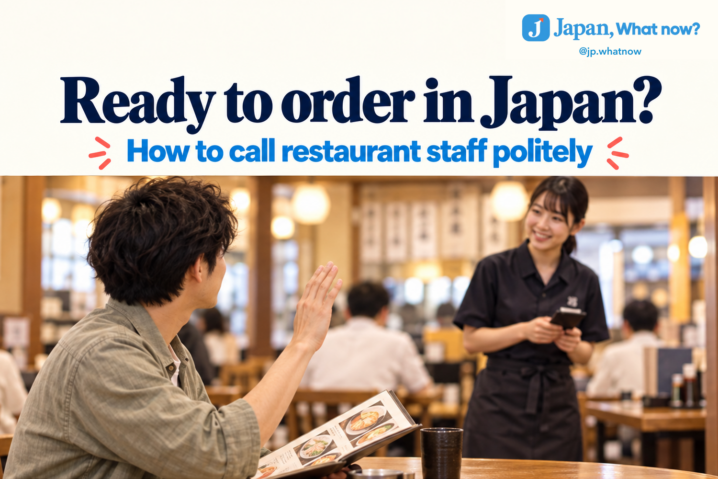
Look towards a server, raise one hand slightly if helpful, and say “Sumimasen” clearly enough to be heard. Match your voice to the room: a quiet café needs less volume than a busy dining room.
You do not need to snap your fingers, whistle, or wave across the restaurant. Once someone acknowledges you, lower your hand and wait.
“Sumimasen” is also used in apologies, but here it means “Excuse me.” You are politely asking for attention, not admitting that you have done something wrong. JNTO lists this meaning in its Japanese language guide.
What Should You Say When Staff Arrive?
A simple “I’d like to order, please” makes your intention clear. If you are ordering for a group, “We’re ready to order” also works.
Point to the item or its number on the menu, and confirm how many you want. For questions that need more detail, such as ingredients, have a translation ready rather than relying on pointing alone.
What If Nobody Responds?
They may not have heard you or may be helping someone else. Pause, then politely try again when a server is nearby. Avoid blocking the aisle or interrupting someone carrying hot food.
Service styles differ. At a restaurant where a server is already guiding you through the meal, follow their lead rather than assuming you need to call across the room.
For a separate question about the end of your meal, see Do I Need to Tip in Japan?.
You do not need perfect Japanese to begin: a polite “Sumimasen,” your menu, and a little patience are a useful starting point.