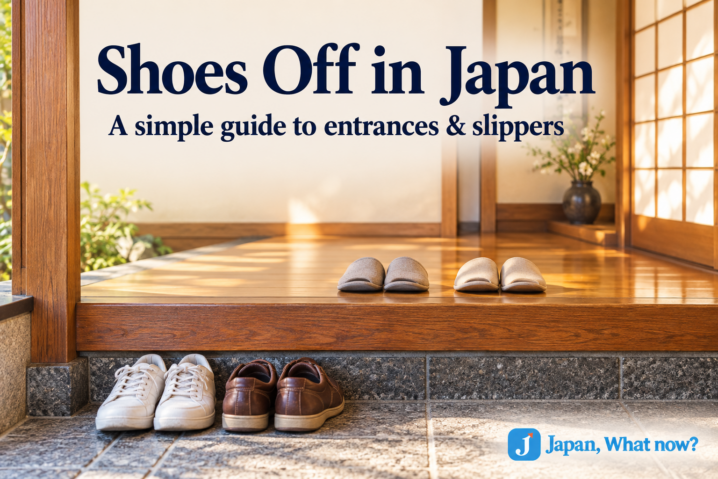
You reach the doorway of a restaurant or ryokan. There is a small step, a row of slippers, and suddenly you are not sure whether to walk in. Take a moment at the entrance: that is the easiest place to check.
Remove outdoor shoes where the venue asks you to, before entering its shoes-off area. Keep slippers off tatami, and ask staff when the boundary is unclear.
How can you tell where shoes come off?
Look for a shoe rack, footwear already stored by the door, slippers, or a sign. 土足厳禁 means outdoor shoes are not allowed. These clues help you notice an entrance boundary; the venue’s instructions tell you what to do.
You may encounter shoes-off areas in homes, ryokan, and some restaurants or visitor attractions. Do not assume every indoor space uses the same system. A traditional-looking doorway alone is not a reason to leave your shoes outside. JNTO describes footwear removal at the entrance and storage to one side or in the provided shoe storage. JNTO etiquette guide
What do you do at a genkan?
A genkan is an entrance area that separates outdoor footwear from the interior, often with a lower floor and a raised indoor level.
- Stop before crossing onto the indoor floor.
- Take off your shoes in the entrance area.
- Step directly onto the indoor floor in your socks, or into the slippers provided. Avoid standing in socks where outdoor shoes have been walking.
- Put your shoes neatly together or in the designated storage. When leaving them by the step, turning the toes toward the exit makes them easier to put on later.
If you need to sit down to change footwear, ask staff for somewhere suitable. There is no need to rush or risk losing your balance. JNTO on entrance etiquette
Can you wear slippers on tatami?
Leave slippers at the edge before stepping onto tatami—the woven mats used in traditional rooms. Clean socks are a practical choice. If you wear sandals while sightseeing, carrying a spare pair of socks can help when a venue asks you to remove your shoes. JNTO footwear guidance
What about toilet slippers?
Some shoes-off facilities provide a separate pair for the toilet area. Change into them there, then change back before returning to the room or hallway. If you accidentally walk out wearing them, simply return and swap them. JNTO etiquette guide
What if the entrance is confusing?
Pause and ask a staff member before proceeding. The shoes-off boundary might be at the building entrance or farther inside. Follow the instructions for that particular space rather than copying a rule from another venue.
If the slippers do not fit, or removing your shoes is difficult, explain the problem and ask what arrangement is possible. Do not force yourself into unstable footwear.
For a ryokan stay, also read our step-by-step yukata guide.
The useful habit is simple: pause, check the boundary, and ask when unsure. You do not need to know every custom before your first visit.